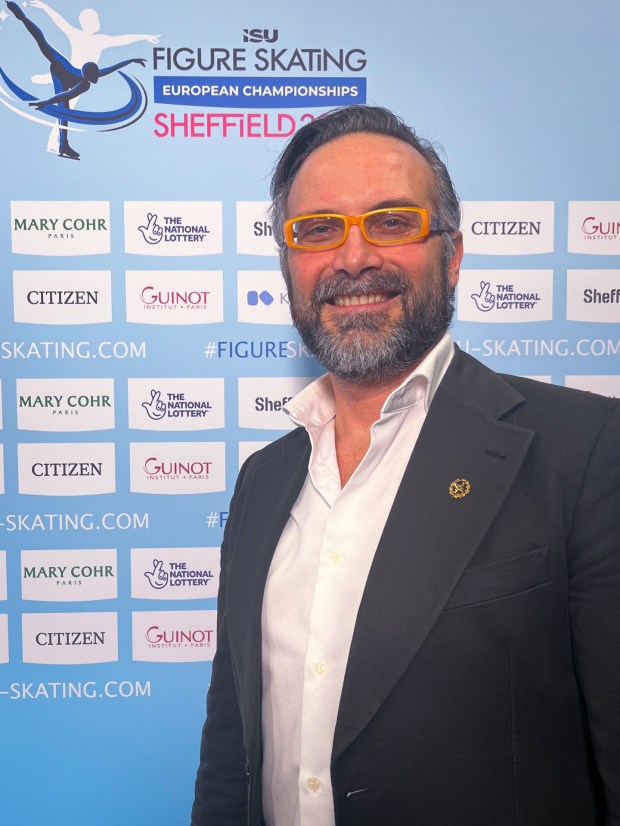
By Hiro Yoshida
Twenty years ago this month, Maurizio Margaglio, with his partner Barbara Fusar-Poli, had a moment at the 2006 Olympics in Turin that is still talked about to this day when people think of those Games. With the Olympics back in Italy and the ice dance event beginning later today, the 2002 Olympic bronze medallist reflects on his competitive career and his current role as coach in Finland.
Following the Turin Olympics, Margaglio hung up his competitive skates and began working as a coach and choreographer.
“After Torino, it was an explosion of work,” he said. “In the beginning, it’s maybe ironic after 2006 I started to work a lot with single skaters. They were asking a lot for choreography and skating skills. I did tonnes of seminars for ice dance skating. Not to skate as an ice dancer, but for single skaters. Meanwhile, I was also helping Anna (Cappellini) and Luca (La Notte) and Massimo (Scali) and Federica (Faiella). I was always giving my advice and lessons to the ice dance couples, but I was never the coach that would go with them to competitions. I was a kind of a freelancer for Italian ice dance.”
In 2010, Margaglio got an offer out of the blue to work with the Helsinki Rockettes, the most decorated synchronised skating team in the history of the sport. This opportunity would take his career on a new course in a new country.
“They were world champions,” he said. “They were supposed to have the World Championships again in Finland in 2011 so they asked me. They wanted to skate like ice dancers, so I went there. We did a beautiful seminar and then they asked me to do choreography. With my choreography they won Worlds in 2011.”
The collaboration went so well that the Finnish Figure Skating Association then asked Margaglio to come on board as their national ice dance head coach.
“I started with the Olympic team in Finland and I became, at that point, a full time coach. I passed from being freelance to being a coach of a national team.”
A schism in the premier coaching camp in 2012 presented the Italian with a chance to work with the top teams in the world at that time. This period served as useful experience for him to develop as a coach and start building his own ice dance school in Finland.
“Marina Zoueva called me because she split with Igor (Shpilband) and she needed another strong coach beside her. I was with her in 2012, 2013 and 2014 with Meryl (Davis) and Charlie (White), Tessa (Virtue) and Scott (Moir), the Shibutanis. It was an incredible three years where I learned a lot as a coach in Michigan. We did back and forth between Finland and Michigan. I tried to bring the young Finnish teams to learn something. It was incredible to have the possibility to coach the top teams in the world, of course. After that, I continued working with the Finnish team, but my idea had always been to create an international environment. I think in Europe it’s important that we cooperate more. It’s the only way to resist to the big power around us.”
After the 2014 Olympic season, Margaglio set about building his school in Helsinki. It was quite a transition from working with the top tier of ice dance to a developmental role in nurturing a new generation. While acknowledging the difficulty in what he had taken on, he relished the test it presented him and the satisfaction in overcoming the obstacles on the road to success.
“It was a big challenge for me,” Margaglio recalled. “It was going from working always with couples that are world champions, Olympic champions, easily in the top five, to teams that don’t even qualify to any competitions. It was a big challenge for me, but there are moments in life where you kind of want to have something really challenging and that was my moment. I’m happy with the work I’ve done and I know that Finland appreciates me a lot.”
Margaglio’s involvement with Finnish ice dance is somewhat of a full circle moment for him. At the first of his eight appearances at the European Championships with Fusar-Poli in 1995, the then 19 year old competed alongside legendary ice dancers Susanna Rahkamo and Petri Kokko who would win their sole European title that year in Dortmund, Germany.
“I entered the skaters lounge and I started to see all the champions that I saw on television for so many years. I was following all the championships and the competitions, so I was excited, but at the same time also very nervous. I remember there after one minute somebody touched my shoulder and it was Petri Kokko. He asked, ‘Are you new here?’ I said, ‘I’m an ice dancer from Italy’ and he said, ‘Come to our table. Stay with us.’ I felt this sense of friendship and community that made me very good friends with Susanna and Petri. I remember they won, and we were 10th at the end of the competition. I had a poster of the competition and I went to ask everybody for their signature. When I arrived to Susanna and Petri, he wrote very big ‘Believe in your dreams’ with his signature. I put it in my room in Milano and it was there every time I went to bed. I had this poster on the wall ‘Believe in your dreams.’ I was not even imagining that one day in five years or six years I will be in the same place as Susanna and Petri so it went very fast. It was an incredible wave that brought me and Barbara so high, so quickly.”
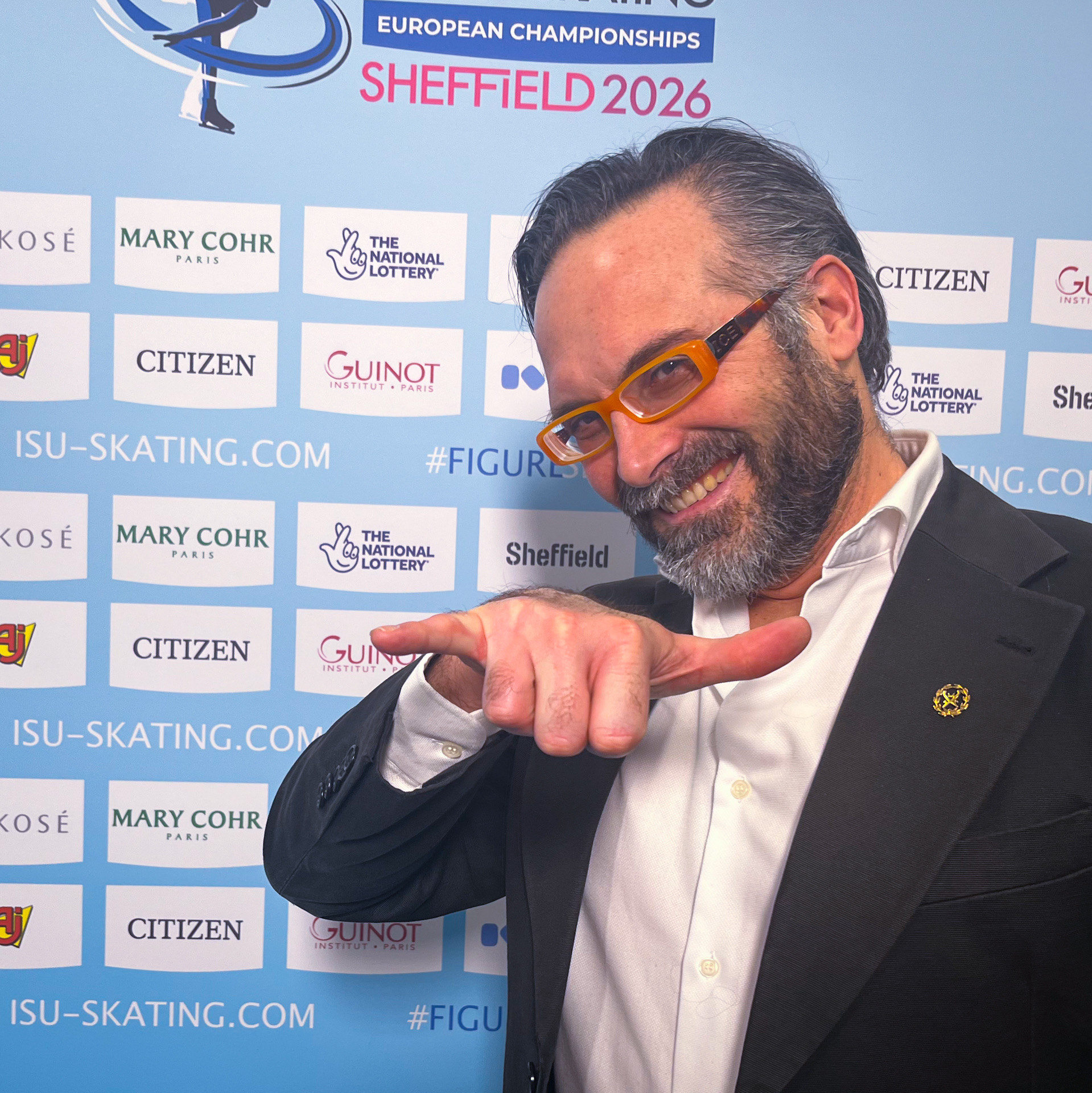
That Europeans in Dortmund was also the origin of Margaglio’s unique hand gesture he used at every competition thereafter as a sort of secret greeting to his brother.
“We were not used to go on television. My brother said, ‘When you are in the kiss and cry, you have to say something special to me.’ But what if there is no mic? The night before I went to the Europeans on TV was ‘Crocodile Dundee’. It’s an old movie about this Australian guy. In one scene, he’s taking a buffalo and doing this (makes hand gesture). My brother said, ‘That’s the sign.’ I did it in Dortmund and everybody said, ‘What is that?’ It was a secret.
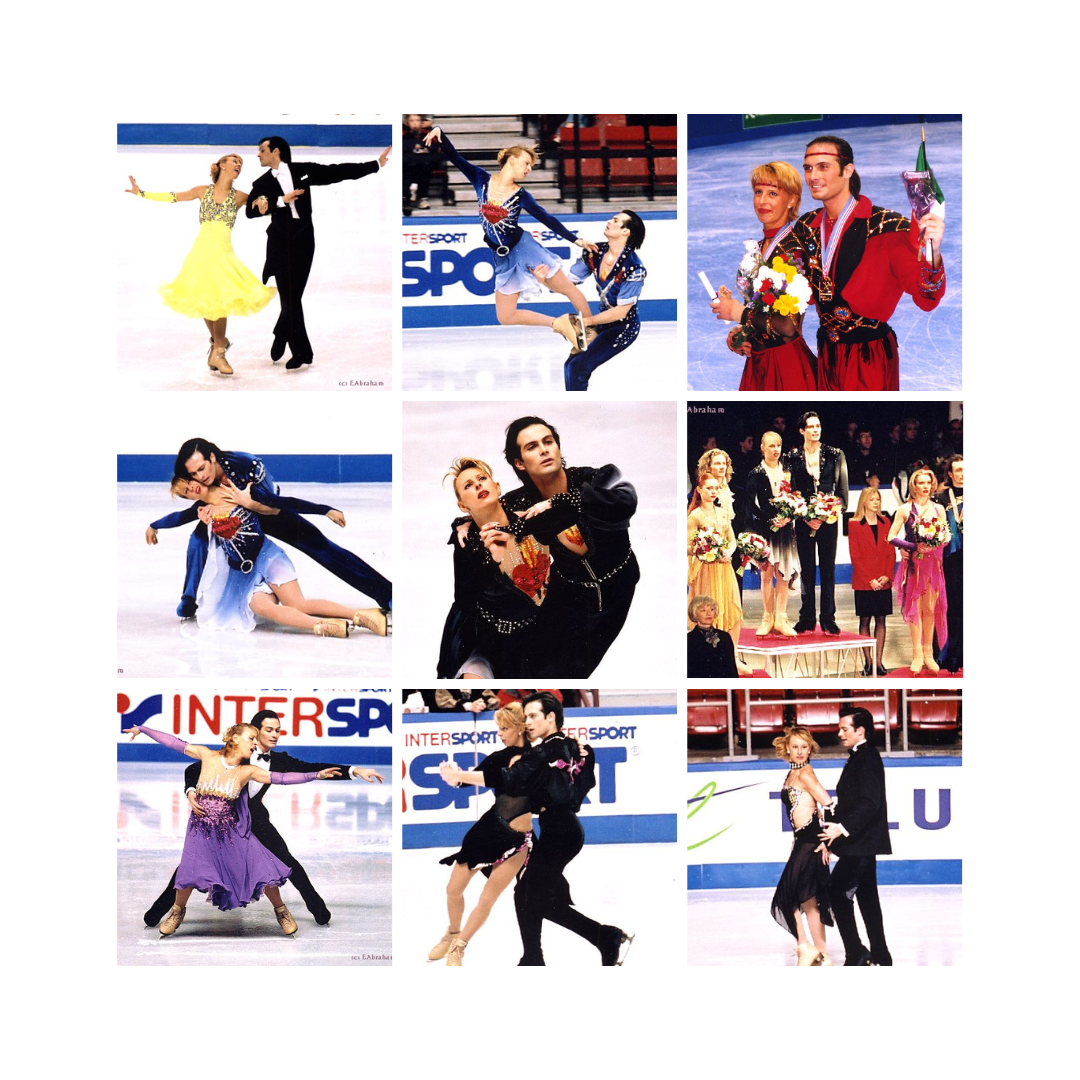
Fusar-Poli and Margaglio became European medallists for the first time in 2000 when they won silver in Vienna, Austria. It was the first time an Italian ice dance team had ever won a medal at the European Championships and the first medal for any Italian skaters in twenty years.
“Of course, I remember this beautiful moment because Italy was without medals for a lot of years.” Margaglio recalled. “We were very lucky because at that time, the best sport newspaper in Italy, Gazetta Dello Sport, the pink paper that sponsored the Giro d’Italia, followed us constantly. They started to write about us and with us skating became a sport that can be on the first page of the best sport newspaper. I think we were pioneers and we opened the door to this incredible generation that we have now from Italy.”
Fusar-Poli and Margaglio went from strength to strength and the following season they won both the European and World titles, the latter particularly significant given the 2002 Salt Lake City Olympics would take place less than a year later. For the Italians, there were positives and negatives extending from that victory in Vancouver, Canada.
“Winning the World Championships just before the Olympic Games has very good points and very bad points,” Margaglio explained. “The very good point is placing you as a top contender for the medals which was not unthinkable three years before. The Olympic Games are always a result of four years. Back in 1999 we were fifth, so not really medal contenders. Winning the 2001 World Championships in Vancouver for us meant we could win the Olympic Games. The bad point is that you get the pressure. It’s not only from the other skaters, or the judges or the coaches. Of course, you pressure yourself because you want more, but there is the pressure of the National Olympic Committee. There is the pressure of the ISU because you are the image of the world federation, so you have to be careful what you say, how you act. At every competition people don’t care if you’re tired, not prepared, or for some reason you had some trouble. You have to show you are always the number one and that’s very difficult because we are humans. We are champions, but we can also have moments where it’s difficult and hard. This continuous pressure was really big on us.”
Their second Olympics in Salt Lake City did not go how they planned. Despite falling in the free dance, Fusar-Poli and Margaglio won a bronze medal. They were done with competing after that.
“I would say in Nagano, we had fun,” Margaglio said. “It was the Olympics that you do that you don’t go to medal, you go to enjoy the Olympic Games. We finished sixth and we were super happy. I remember I had so much fun. 2002 was the pressure one because everybody just wanted us to win. There was only one result, winning, and that’s really hard. Salt Lake City was not an easy Olympics to participate in. Plus, we had the big scandal with Russia and France and the couples in front of us were Russia and France. I think this was giving me and Barbara very difficult times because we got the medal, and we’re still thankful to everybody that was involved in our journey, but we thought that we were missing something. After the scandal, there was the change of the system and a lot of things changed in our sport. I remember in Salt Lake City Barbara told me, ‘I don’t want to skate anymore for the judges. I want to skate for the public and enjoy.’
For the following Olympics in Turin, the Italians were ambassadors promoting the upcoming Games and as they approached the temptation for one last big competition before their home fans became too hard to resist.
“In 2005 at the beginning of the year we inaugurated the opening of the Palavela. The first people touching the ice of the Palavela were me and Barbara. They just finished the rink. They put the ice and they said, ‘You have to be the first and we stepped on. It was a small show for 200 people. We did this show and while we were skating, we were crying, literally, with tears. When we came out of the dressing room, I said, ‘We cannot miss this. It’s so powerful, the emotion.’ Barbara for three years always told me, ‘No. No way, no way.’ But that day, she looked at me and she said, ‘Let’s do it.’ We didn’t talk too much because we had to do the event. The next morning, we went to breakfast. I remember sitting down and I said, ‘Barbara, yesterday when I said, let’s come back and you said, let’s do it were you joking or you really believe it after last night?’ She said, ‘I think we have to do it. It was so strong the feeling.’ So, we started to prepare for the comeback.
“We were not done in Salt Lake City. It was kind of personal. We wanted do the last chapter. I remember, it was, in general, a good preparation, probably the best year. We were working a lot better than in the past. Of course, it was difficult because we had to learn the new system. This was the problem. We cannot bring our old skating. We have to bring a new way to skate.”
Fusar-Poli and Margaglio did not compete at a single international competition during the 2005-2006 season so they and their coaching team arrived in Turin unsure of how they would be received by the judges. They got off to a remarkably good start in the compulsory dance.
“We entered Torino without expectations,” Margaglio said. “Our coach the day before said, ‘Maybe you will be 10th.’ This was really our coach telling us that and we said, ‘We hope a little bit better.’ Then we did the Ravensburger Waltz and we were first. I think we were at first shocked. ‘Wow! we’re first again and in Italy and it’s the Olympics?’ It’s what we didn’t get in Salt Lake City. That evening and the day after, I think we touched the sky in our career, in our feelings, in everything.”
However, the Italians learned of a potential problem with their free dance the night before the original dance. They chose to try and fix the issue ahead of the next segment of the competition.
“Of course, we had big pressure and somebody made a rumour that we had an illegal element in the free dance and, because the rules were new, everybody was afraid that we could have something illegal,” Margaglio said. “In the end, the team decided to go to the ice for practice that we had cancelled. It was very late the night before the original dance and we had to change the combo lift of the free dance in 30 minutes. We were the only couple doing that evening practice, no one else. In competition, you can use only your half an hour. You cannot use the rest. The ice was empty for three hours, but we can use only our slot and have the music play only once. You can imagine it was a nightmare. At the end of the half an hour, we were super nervous. We found the solution. I don’t know how, but we did.”
Although the issue with the free was solved, the stress surrounding it was what had an effect on their performance in the original dance where both Fusar-Poli and Margaglio fell with just seconds remaining. What followed was half a minute of the on-ice partners staring each other down that set off a media frenzy still remembered to this day.
“For the original dance, we were off,” Margaglio said. “It was something that disturbed our mind. We skated very well, but we had the fall in the last moment. We just saw our career passing in front of us and we stood facing each other for 30 seconds just watching and silent. We didn’t realise that we did the longest look in the history of sport probably, but we were just like that for 30 seconds not talking.
“We were shocked because it was in the last three seconds and we could not recover. We knew that our dream was gone. In that picture you see only us watching each other and people think that it’s only between me and Barbara, but it’s not. We saw behind the people of our federation who were against us coming back. We saw the people in the audience that were our family and friend and we were proud to be there for them. It was so many things. In 30 seconds, we had the movie of our life.”
Their mistake dropped them from first to seventh. Unaware of the impact their facedown had, Fusar-Poli and Margaglio left the arena to prepare for the following day’s free dance. Despite their best efforts, the next morning they began to realise how widespread the coverage of what had transpired in the original dance had been.
“Believe me, we went silent into the mixed zone,” Margaglio said. “We changed. We went to the village. We slept in the same apartment. We had two rooms with our physiotherapist. We said good night. The next morning, we said, ‘Let’s go to skate. Let’s do the free dance.’ I remember I went down for breakfast in the Olympic village and somebody came to me and said, ‘Are you okay?’ And another one came and said, ‘Are you alive?’ ‘Yes, I’m alive.’ In my mind, I had the competition and nothing else. I mean I was frustrated about the night before, but it’s life. After 10 people like that, I asked my physiotherapist, because we turned off our telephones, we didn’t have any messages or read any newspapers, what’s going on. He said, ‘I have to tell you every half an hour all the Italian television stations are putting your image with Ennio Morricone and Sergio Leone music, the Italian spaghetti western. You and Clint Eastwood, Barbara and Lee Van Cleef and it’s a duel.”
That evening Fusar-Poli and Margaglio came back out on the ice in the Palavela as the latest talking point of the Games to huge interest from those watching in the venue and at home. That moment from the original dance was now etched in the memories of all who had seen it and is iconic for fans of the sport.
“The media made so much hype and when we skated in the evening, it was incredible,” Margaglio said. “The emotion of the public for us. Some people thought that we killed each other during the night. Some people thought, would they skate or not? We just pulled everything off. We knew that this is our last exhibition. Our last exhibition was in such an incredible drama, and was our last time skating together in a competition. We did pretty well. We finished sixth which is not bad. But the point is we came out from the rink and a very famous journalist told us, ‘You won the Olympics.’ And Barbara said, ‘No, we’re sixth.’ He said, ‘No, you don’t understand. When there is a sporting drama, you win’ and he told us, ‘You will see. Nobody will remember the top three. Everybody will remember you.’ And now I’m asking you, who were the top three in Torino? It’s hard to remember. If you talk about Torino 2006 and you talk about us, everybody’s says, ‘Yes, I remember those two.”
Even though they did not win in Turin, there was an outpouring of affection from the Italian public for what they had shown at those Olympics.
“We received thousands of letters,” Margaglio said. “These things somehow make the people love you. What changed for us was that before we were considered the golden couple and we only win. We are gods in Italy, in sport. After that, we became humans. I received a lot of letters and most of the people said, ‘Thank you for representing me.’ I think normal people have a beautiful day and then something goes wrong, but you have to keep going. Our Torino we were first in the Olympics the first night, last the second night, losing everything and coming back and showing ourselves. It was a four day metaphor of a life. People started really to love us after that.”
Margaglio gets to experience another Olympics at home, albeit on the other side of the boards and feel grateful and fortunate to have the opportunity in his hometown.
“First of all, I’m very lucky to have experienced in my life two Olympic games at home, one as an athlete, another one as a coach of beautiful teams,” he said. “I always say that in sport you have to be very good, very smart, very strong, but first very lucky. Everything has to arrive at the right moment. I’m forward to it so much because Milano not only is the city where I was born, it is the city where I grew up. It is the city where I skated. It is the city of my friends. It is the city where I lived for 36 years.”
While his heart is in Milan, Margaglio now calls Helsinki home. He lives there with his German wife Jyrina Lorenz, a former figure skater. Between them they have four sons and enjoy living in a multilingual household.
“My wife was in Milano for 12 years, living in Milano with me and we had our first two kids in Milano,” he said. “She speaks Italian fluently with no accent. At home, we speak Italian, but the kids go to a German school in Helsinki, so they speak German in school and of course they speak German with their mom. I would say that German and Italian are for them both their mother tongues. We are 15 years in Helsinki so they speak Finnish fluently. With their friends and when they do sport, Finnish is their language. Like every good Nordic country, in Finland everybody speaks English. We have four languages and it’s fun to be home with us.”
Although they have figure skating in their DNA, Margaglio’s sons have no intention of following in either of their parents’ footsteps when it comes to sport.
“Our kids know how to skate a little bit, but they choose different sport and we follow what they want. We never forced anybody to do skating. Tennis and soccer are the two sports that they’re doing.”
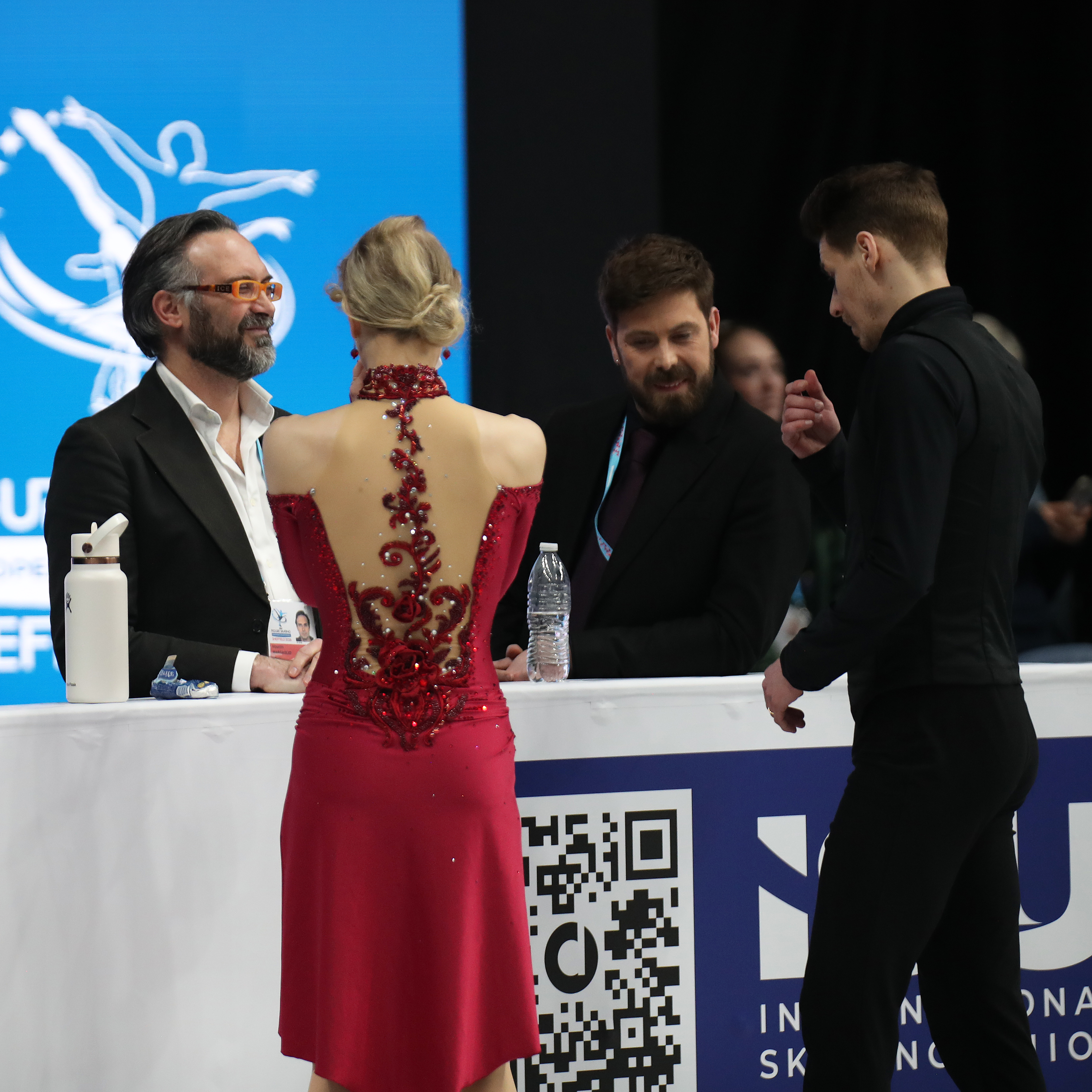
As well as the top two Finnish teams of Juulia Turkkila and Matthias Versluis and Yuka Orihara and Juho Pirinen, Czech siblings Natalie Taschlerova and Filip Taschler made the move to be coached by Margaglio in May of last year. Finland will host Worlds in 2027 and while he is looking forward to that for now his focus is on Milan and then next month a home Worlds in Prague for the Taschlers.
The World Championships in Finland will be in the Nokia Arena in Tampere, which is a big arena for hockey normally with 15,000 seats,” he said. “It’s really huge and Finland is great for organising these events, so I’m expecting an incredible World Championships.
“But now I will focus on Milano. This will be my first project and then also the Worlds in Prague. Having the Taschlers is also magic. We are enjoying it so much. We will do the Olympics at home and then the Worlds at home and then the next Worlds at home again so it’s nice. Natalie and Filip are a great new addition to our group.”
Margaglio’s philosophy of coaching is to create the conditions where his athletes can explore their individuality and thrive.
“I think we try to let every skater have their personality and to have a very good and a safe environment. Today, it is very important that the athletes feel their wellbeing and that they can express themselves freely. It’s a challenge for all the world of sport and for coaches as well because we have really to change.”
Overall, Margaglio is satisfied and grateful with what he has achieved professionally through his involvement with figure skating both as a competitor and coach.
“Honestly, I think I had quite a happy life all the time. I try to enjoy as much as possible what I’m doing. I try to follow my passions. I try to give meaning to my life. If my life is a book, I would like one day that somebody wants to read it with interest, that I left something nice, that I gave a lot. I hope to give more than what I got and because I got so much from the people, it’s difficult to give more. I’m trying to do my best.”
 europeonice.com