
By Hiro Yoshida
After becoming World champions in March 2024, Deanna Stellato-Dudek and Maxime Deschamps struggled to reach the same heights last season. As they approach the pinnacle of their careers in February 2026, the Canadian pair channelled that disappointment into motivation for the Milano-Cortina Olympic Games.
While their competitive results in 2024-2025 might not have been what they had hoped for, there was one big success and hurdle overcome off the ice for Stellato-Dudek and Deschamps. On 11 December 2024, Stellato-Dudek received Canadian citizenship which she required to be able to compete at the Olympics. It was a relief for the duo that a formidable obstacle had been cleared from their path of making the Canadian Olympic team.
“I had no clue it was coming,” Stellato-Dudek recalled. “You file all the papers, and basically you hurry up and wait. I got a call from my citizenship attorney. I actually have the entire thing on tape because I had a feeling when he called me, as he doesn’t normally call me, it’s either bad news or good news. I was hoping it was good news of course. Happy is not a strong enough word to describe how I felt. This is a dream I’ve had for a long time to go to the Olympics, and we needed that citizenship in order for that to happen. For Maxime and I, we always had 2026 as our plan, even in 2019 when we partnered because we knew 2022 was impossible to get citizenship by. We were just over the moon that now the ability to realise a dream is really possible and there’s not an outside unknown factor, like citizenship, that might not come through on time.”
“I see how she was every day becoming being more and more Canadian in her personality,” Deschamps said. “Now that she’s fully Canadian it’s great and I’m proud of her. She tried to learn French a lot. She’s working hard on it as Quebec is French and she tried to really embrace it. She embraced Canada so much and she loves it.”
Following their fifth place finish at the 2025 World Championships, the pair decided on making a few changes. The first thing on the agenda was increasing the technical difficulty of their routines.
“We knew from last year that we really needed to improve the jumps, and we had to add that triple-double-double combo to be competitive with the top field,” Stellato-Dudek said. “We immediately got to work on that and we did a lot of hours this summer, many, many hours on the ice, and most of them were spent jumping to try to get more consistent with the triples, and then also get that extra combo in there that gives so many points.”
Creatively they also opted this season to work with renowned choreographer Lori Nichol on their programmes. For both Stellato-Dudek and Deschamps it was the fulfilment of longtime ambition.
“When I skated before in singles skating, Lori was doing Michelle Kwan’s programmes, and everybody who was anybody had a Lori Nichol programme,” Stellato-Dudek said. “I always wanted to work with her and I was actually supposed to work with her as a singles skater. Then something happened, it fell through, and then I stopped skating. So I never got to work with her.”
“My favourite skaters, my idols, were Jamie (Sale) and David (Pelletier),” Deschamps said. “I decided I really wanted to go to the Olympics when they did their ‘Love Story’ programme, which was choreographed by Lori. I’ve always dreamed of working with her, and this year was the perfect opportunity.”
“We actually talked about it at our try-out if there was anyone who would you want to work with, if you could have any choreographer to work with,” Stellato-Dudek continued. “We both said Lori Nichol. We thought maybe one day, if we get to a certain point, maybe we’ll get the opportunity to work with her as a team.”
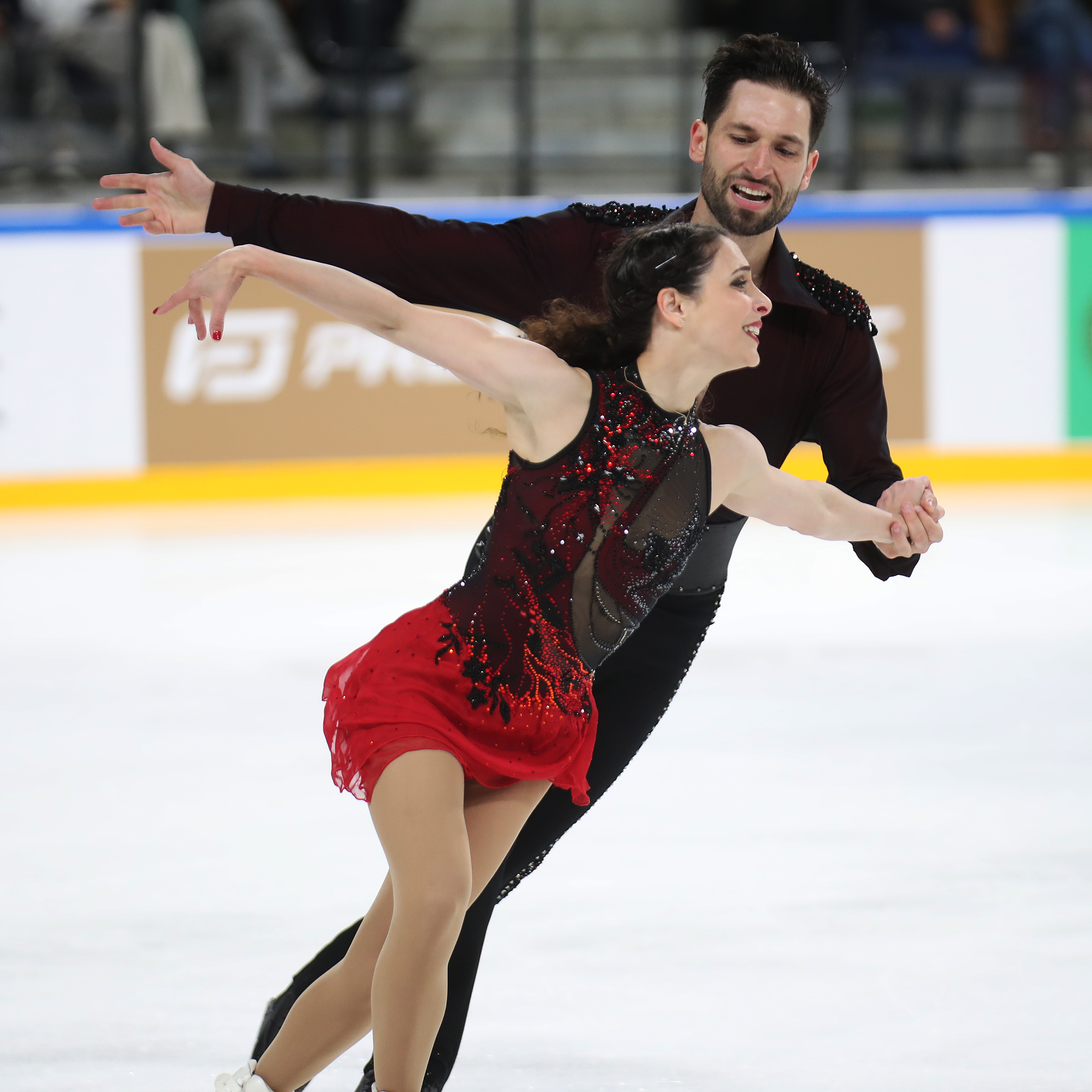
This season they will be performing to “Carmina Burana” for their short programme and “Poeta” for their free skating. They collaborated with Nichol on deciding music for their routines with a number of factors coming into play that made the process challenging.
“This year it was really difficult because there’s a lot of music licencing issues which seemingly not everybody is following so it’s very confusing,” Stellato-Dudek said. “I had a lot of options on my list, but we kind had to dwindle it down to see what would be legal to skate to. Lori also had some suggestions as well. Of course, we have to love what we’re skating to, otherwise, it’ll never work. It was very much a group effort to choose the songs that we were skating to and then also, as I love a good theme, the themes of the songs.”
The Canadians also unveiled a new move in their short that made waves when they competed for the first time this season at the John Nicks Pairs Challenge – an assisted backflip. Backflips in any shape or form were banned from competition by the International Skating Union until last season. The trick has mainly been displayed by skaters in the men’s singles category. Stellato-Dudek wanted to show women this was also something they could do opting for a different take on it specific to pairs.
“I’ve been asking Max to do it for over a year and he kept on saying no because he thought it was too dangerous,” Stellato-Dudek said. “I grew up competing in gymnastics and skating. I competed in gymnastics for over 10 years, so I was doing double backs and fulls. A single backflip is really, truly, not a big deal for a gymnast. In the 90s, when I was growing up, I remember seeing Surya Bonaly from France do it illegally at the Olympic Games. As a young girl being a gymnast and a figure skater at that time that I was, ‘Oh, my God, my two loves, combined into one thing. She backflips, but she’s got skates on.’ I thought it was so cool. When I came with the idea to do it with Max, I really wanted to give the new generation of young girls who have never seen Surya skate see a girl do a backflip because right now, it’s only the men who are doing it. I just want to show that the women can be just as acrobatic as the men can and we can play the backflip game too. I wanted to make it specific to pairs. I didn’t want to do a side by side backflip because any singles skater can do that. I wanted to make it distinguishable, a pairs element. That’s where the assist came from.”
Foremost for Deschamps in his hesitancy was his instinct to protect Stellato’s from injury when performing the trick as he knew the risk for him would be minimal.
“I was not worried about Deanna’s blade because I am in control of her foot and pushing it away from me to give her resistance to catapult herself into the air. This was never a concern for me. I was more concerned for Deanna’s safety as it is the man’s job to protect the girl, even from herself since this was Deanna’s idea,” he laughed. “At first I said, ‘You’re crazy. It’s too risky for something that has no value.’ But when we went to the gym and she was able to do it the first day, I said, ‘Okay, let’s go. Let’s do it. We got this.”
Two weeks ago, Stellato-Dudek and Deschamps competed at their first Grand Prix assignment of the season in Angers, France. In the short, they skated cleanly and scored 74.26 points to place second in the segment. The free got off to an unusual start as they popped their normally reliable triple twist into a single and struggled on several elements afterwards. They were awarded 123.40 points for the free to give them a total of 197.66 which kept them in second place overall. At this weekend’s Skate Canada in Saskatoon, they will be trying to learn from what happened at Grand Prix de France.
“What we have been doing at home has been going pretty well,” Deschamps said. “Any athlete who will do a major mistake on the first element will have a hard time after, because the first one is what gives you the mood for the programme. The fact that we were able to keep it together and still fought for everything showed the training we had. We’ll keep training like we have been doing. Maybe we can find a cue to really get back together if something major happened, so it doesn’t disrupt it all.”
“That has never happened in practice with the twist,” Stellato-Dudek said. “We were both in shock and I was not thinking about the triple toe going into the triple toe. I was thinking, ‘What the heck happened twist?’ It really took our focus out of the moment. But we did fight through the whole programme and also it’s the first time that we’ve actually done a triple-double-double in competition. I was able to do the triple Sal, which I was proud of. Max knows exactly the mistake he made. We still did both throws. We fought quite hard, and the things that we were the most unhappy with were the twists and the lifts, which are what we’re best at. That’s not going to be hard to fix. It’s just going to be a minor little alignment thing and it will go back to normal.”
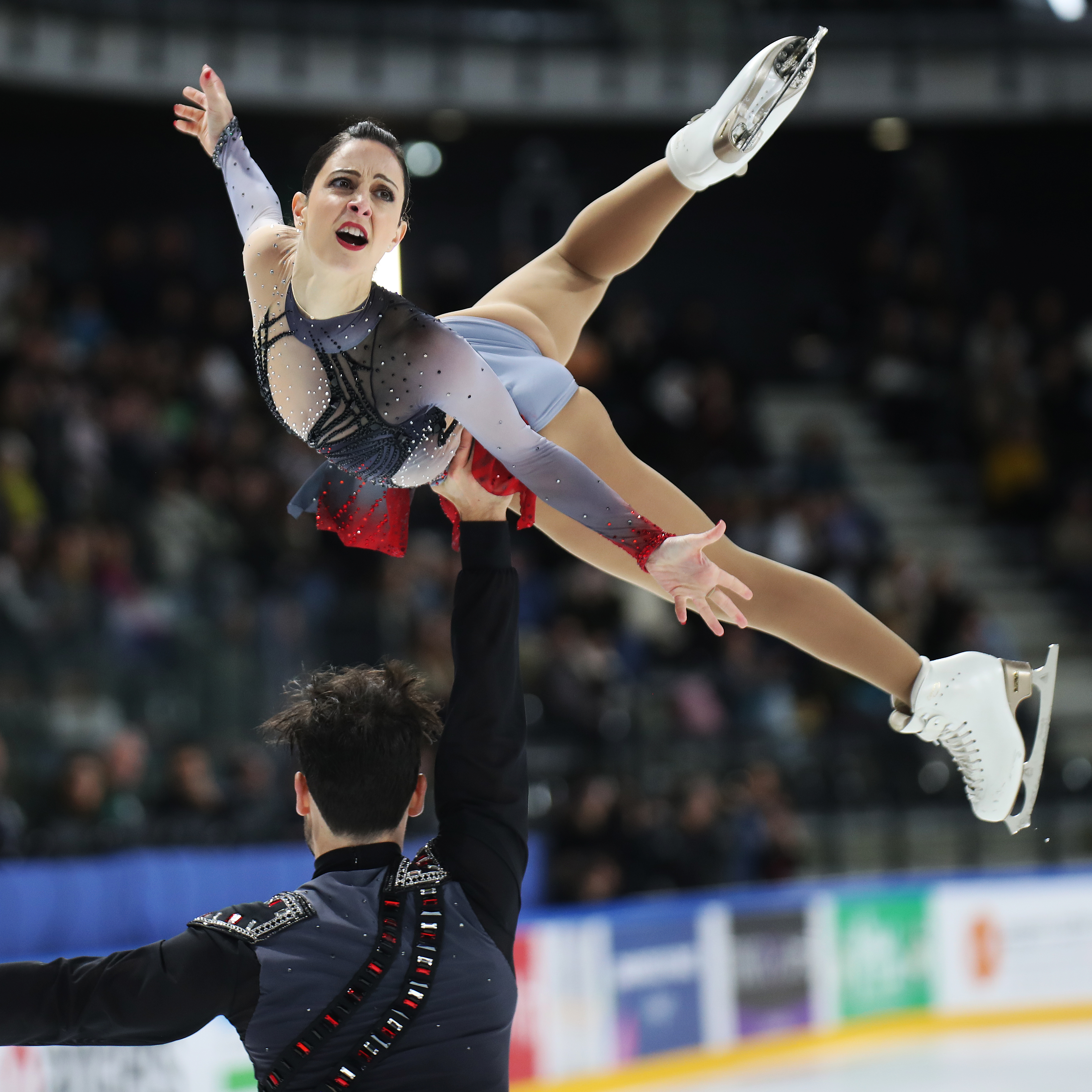
The Grand Prix Series and everything that happens over the next 100 days is all a prelude to the main event when Stellato-Dudek and Deschamps finally become Olympians. As an American and now Canadian with Italian heritage, Stellato-Dudek is excited to be able to compete in front of the entourage of family members who will be there to support her and Deschamps as they aim for Olympic glory.
“We have a lot of people coming to Italy,” Stellato-Dudek said. “I still have family there, so some of them are going to come to watch me, and then people who are flying from Canada and America to come watch us. We’re going have our own cheering section. As my cousins say, ‘Well, I have to come. When am I going to have somebody in my family go to the Olympics ever again?’ It’s going to be a wonderful experience and, of course, Max and I want to be on the podium. It’s been a lifelong dream of ours, but we know we have to put out some better performances for the rest of the season in order to get there.”
Each of the biggest competitions of the current and past two seasons have had personal connections for the pair – a World Championship title in Deschamps’ hometown followed by a Worlds in Stellato-Dudek’s country of birth and an Olympics in the nation from which her ancestors came. For the Canadians, it feels like preordained destiny and the fulfilment of a lifetime of hard work and sacrifice.
“I always think about how serendipitous my comeback is, and how things had to fall into place in order for me to even be here,” Stellato-Dudek said. “The fact that there’s three huge events in a row, all of which have a deeper meaning to me, is just proof that I’m meant to be here. This has been a long and hard fought dream for me to hope against hope that the day would finally come where I can go to the Olympics. I am so happy and excited that the time is finally here. Maxime and I just want to work hard, perform well and stay healthy and injury free so we can both finally realise our Olympic dreams together.”
 europeonice.com
One comment