
By Hiro Yoshida
Minerva Fabienne Hase and Nikita Volodin had an almost golden 2024/2025 season. As the German pair look ahead to the upcoming months leading up the Milano Cortina Olympics, they are aiming to reach even greater heights in their career.
In just two seasons of competition together, Hase and Volodin have enjoyed a meteoric rise. March 2025 culminated with a standing ovation at the World Championships in Boston, United States of America where they won the free skating segment and were narrowly pipped to gold by Japan’s Riku Miura and Ryuichi Kihara by less than one point. Despite missing out on the title, the 2025 European champions were happy to end the season on a high in such a positive way.
“I was so surprised that for the free programme pairs that it was so packed,” Hase said “The audience were great. They were really loud, really supportive to all the teams which you don’t have that often on that scale.. It’s crazy that we skated in an arena where normally an NBA team or an NHL team have games.”
“It was amazing all these wonderful people ready to watch a big competition,” Volodin said. “If you fall they support you. If you don’t make a mistake they support you.”
While they are at one on the ice as a team, the duo each have very different approaches and psyches ahead of competitions, particularly where big titles are on the line.
“The funny thing is for me every competition is the same,” Volodin explained “Grand Prix Final, Europeans we prepare our best and show our best in this moment. There may be some difficult preparation before we skate, more programmes before Worlds especially. Yes, that’s difficult, but the competition feeling, I think for me, it’s always stable, the same.
“So jealous,” Hase laughed. “Last year, I was also nervous, but this year ahead of the short, it was okay. I was nervous, but I had it under control. Before the free programme, the whole day was okay, and then after the six minutes before we went on the ice again, it was bad. Dima really had to talk to me the whole time. I couldn’t do anything. I was just standing there and I was freezing. It was crazy.”
“I saw it,” Volodin said. “I was listening to music.”
“It was good that he was doing something else,” Hase said. “I was just staying in front of Dima. I said, ‘Just help me. I can’t.’ He tried to really talk to me, say all the positive things, remind me of everything and it really helped to stay in the moment and not totally freak out.”
With the weeks of stressful build up and backstage jitters dispersed, Hase and Volodin went out on the TD Garden ice to have the skate of their careers scoring a new personal best free score of 145.49 points.
“I was lucky,” Hase recalled. “As soon as the music started, my head was free. Everything was gone. I was in the moment, and it was really good. The previous two weeks I was constantly nervous, stressed. You would have seen it at our practices in Connecticut. I was freaking out once in a session. My combination didn’t work at all.”
Aside from Worlds, the German had only one other loss the entire season at Cup of China to Italy’s Sara Conti and Niccolo Macii. They had beaten the Italians at their subsequent face-offs at the Grand Prix Final last December and Europeans in January. The latter victory was particularly sweet given that they had missed the podium entirely in 2024. While their wins had boosted their morale, they also felt the weight of expectation as the weeks and months progressed to keep the momentum going and not finish things on a low.
“At Worlds, we were confident because we knew we had skated well so many times in the season, but there was also more pressure because you wanted to show good skating again and not do a worse performance.” Hase said. “If you end on a bad competition, you have to wait for five or six months to start again so there is more pressure to just do it. It was not pressure to win.. It was pressure to do a good performance because I think people started to expect from us to skate well. I think that was more pressure than winning or a medal.”
While their objective coming into Boston was to skate to their potential, they were also very clear on who their main challengers for medals were going into the event.
“We knew from beginning that if the Japanese skate clean, they’re the biggest rivals for us,” Hase said. “We also knew that Sara and Niccolo were getting better throughout the season, and they got stronger with each competition and if they skate clean, they also get the same components as us. We knew from beginning they will be the top contenders for the medals and everyone else it depended on how we would skate and how clean they would skate. It was more about if we make mistakes, they have chances to beat us. But if we stayed clean, I think Italy and Japan were the two we knew from beginning will be the hardest. Nikita said it really well in a German interview we did before Worlds. He said, ‘It’s sport. The Japanese never skate clean. It’s hard to just say if they skate clean, then they will be better.’ And the short they did a really good performance and then the free they kept it together.”
They were also aware that they needed to without any errors in both of their routines in order to get the result that they wanted. Even though they were satisfied with their overall performance, they did not believe it was totally reflected in the scores in comparison to other events earlier in the season.
“We knew we had to skate as clean as possible to get the points,” Hase said. “What this competition also showed is that this was not super easy. For example, at Grand Prix Final. I think we almost skated the same kind of short programme, to be honest, and got three points more. At Worlds there were some a little more shaky elements, but not that much, and we get three points less. It always depends on the competition, but that’s sport. I think it’s important that we showed that we are in the top three, that we’re consistent and that we can fight for medals in the next season as well.”
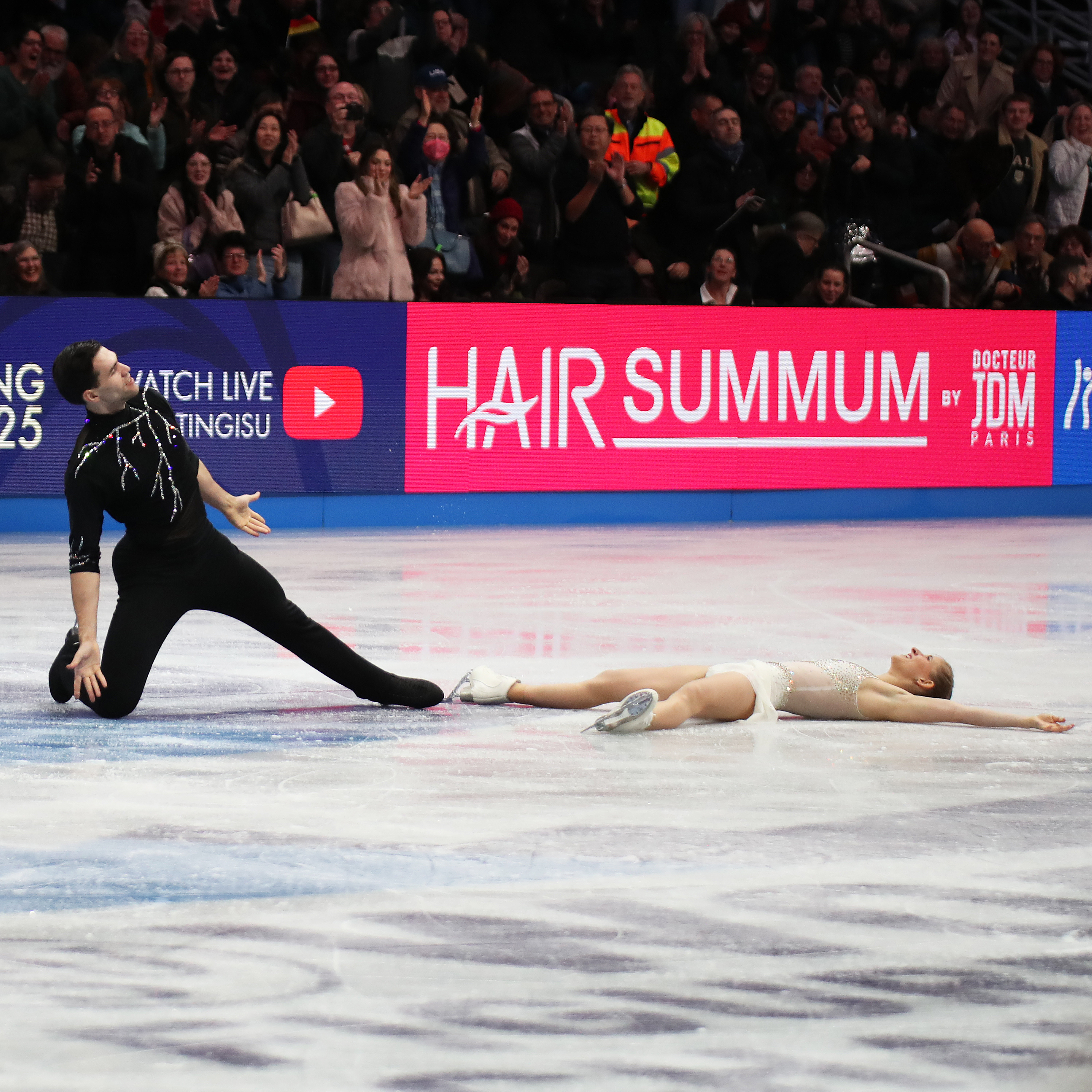
Overall, they were glad to finish out the season on a high and the relief they felt was encapsulated when Hase collapsed to the ice after they completed their free in Boston in one of the most emotional moments of their career.
“I think it was sort of just all the pressure from the last days fell off in that moment that we made it,” Hase said. “I was thinking, ‘Okay, do I keep standing?’ In one moment, my body was just bam on the ice. The next thing I remember was, ‘Damn. I think we did it?’ I think Nikita was thinking, ‘Drama Queen again.’
“I was thinking it, but it’s okay,” Volodin said. “It’s your time.”
“This free programme was one of the best we skated the whole season,” Hase continued. “It was also a nice circle moment because we started at the Nebelhorn Trophy with a clean skate and a standing ovation and now we could end the season with a standing ovation at a World Championship. When I came to my knees, I saw everyone standing which is something that is not happening often. I think it’s the first time for us on a big stage that it happened. I almost started crying on the ice because that was special, and I know that I will remember this moment for many, many years.”
While they were not standing on the top of the podium as they had done at the Grand Prix Final and Europeans, their World silver medal carries greater significance for them as an achievement.
“It’s more important,” Volodin said. “Grand Prix Final is different. Europeans is the best in the continent of Europe. I think Worlds is the biggest in our minds.”
“It was nice to win the European title after the bad performance last year,” Hase said. “We, for sure, had a little bit pressure at that competition. But the World silver, and especially the small gold and the free programme, I think is a lot more worthy in terms of fighting for next year at the Olympics. It was so close to gold, so I think the silver is worth more in our hearts now, especially because both programmes were much better in execution.”
Ahead of the new season, they are a few things they are working on. The priority is Volodin obtaining German citizenship which at the time of this interview required the Russian native to pass an exam in the German language.
“It’s under control,” Hase said. “He’s learning so much German.”
“I need to be better in German,” Volodin said. “I think the problem is that it’s not close to Russian. I have to concentrate so much. For speaking English, not so much. I can just pick up something. For German, I need to concentrate and put the right word in the right place.”
“He’s not afraid to just talk,” Hase said. “I think that will help him a lot on the test to just say something.”
German figure skating magazine Pirouetten reported on 10 August 2025 that Volodin had passed the language and naturalisation tests required for his German citizenship application.

Preparations for the new season for the Germans will entail ensuring they squeeze the maximum amount of points from every element and leave nothing on the table.
“It’s always about technical content,” Hase said. “We will work for sure on the levels so that we have everything level four. That’s something we want to achieve – to be one of the best, skate as clean as possible with the best technical and presentation marks. We will not change a lot in preparation but just continue working like we did the last summer, and we’ll work even harder for the next season to really get it.”
“We think about technique so it should be at a high level,” Volodin said. “If we can do that, I think we have a good chance to beat everybody.”
One element Hase and Volodin are aiming to upgrade is their twist lift for which they have yet not been able to receive Level 4.
“It’s just my split,” Hase explained. “Everything else is super clean. On off-ice we pretty much do it all the time now, so this is also a step closer to make it on the ice. The first season, we also didn’t do it off-ice. We are working every day so much on that split. I’m doing exercises between the twist to make my muscles stronger to do it. I try to be more flexible to make the split. We’re working hard, but on the ice somehow we always not panic, but it’s hard for us to get it on the ice. Our coach already said he watched now all the practices, the competition, and he has new exercises coming up for us, so we will continue working hard to get that split.”
“We need to change the preparation about split and we start earlier than last year,” Volodin said. “I think it’s a technique problem for both of us.”
The difference between the base value of a Level 3 and a Level 4 twist lift is a mere 0.5 points. However, given how tight margins are between the top pair teams every single point may prove to be crucial, particularly in the short programme.
“For the short, every single point is so important,” Hase said.
“In the short everybody’s usually so close,” Volodin said. “At the Olympics, everybody is going to give their maximum performance, and this 0.5 could be the difference between first place or the fourth place going into the free programme.”
At Boston Worlds, Hase and Volodin were third after the short and admit to being hesitant and afraid of making a mistake with so much on the line. This is another aspect of their skating they are seeking to improve.
“In the free programme, you have so many elements you don’t think so much about if you do one mistake that it’s over,” Hase said. “But in the short if you do one mistake, it can cost you the last group and we all know to skate in the last group is what you always want. You’re always a little bit more tense in the short programme to do it clean, and, then you start to take down a little bit the presentation and play it safe. We have to work for the Olympics on that – to not play it safe, to be ready that we can do both together.”
The Germans will have two brand new routines for the Olympic season. Their short will be choreographed by Mark Pillay and Paul Boll to an original piece by French composer Maxime Rodriguez with their free by Benoit Richaud to “Memoryhouse” by Max Richter.
“It’s going to be unique, for sure,” Hase said about the short. “No one will have the same kind of music which is nice. We wanted to create something special, something new. It will be interesting getting into a new style and explore ourselves once more in a completely different way.”
If either or both of their new programmes do not work out, Hase and Volodin are competing in the knowledge that they have two strong routines in reserve from last season. However, for the moment, they are content to leave them to one side as a reminder of the success they enjoyed with fondness.
“If something happens with the new programmes, we can always go back,” Hase said. “We have everything fixed with the music rights for our free programme. If we have any problems with music rights for the new programme, we have that one. But I think it’s nice to also end these two programmes just with good memories. The whole season we achieved good results with them and it’s nice that it forever will stay like that.”
 europeonice.com