
By Hiro Yoshida
Yanhao Li has been a trail blazer for New Zealand’s figure skating community over the past few seasons and this week he has his sights set on making more history for his country at the World Junior Championships in Debrecen, Hungary.
Li began skating in Beijing, China where he was born. Destiny, proximity and necessity all played a part in him taking up the sport at the age of four.
“Summers in China are really hot, so it was a way to cool,” he explained. “There was a commercial rink right next to my house in Beijing.”
When Li was eight, his family emigrated to Auckland, New Zealand where he has been training under the instruction of his current coach Bess Cao who is also originally from China.
“Before I went to New Zealand we contacted her,” he said. “She was a single skater at national level and then after that she decided to retire and start coaching. She started coaching in China, and then she moved to New Zealand.”
Li is a full-time high school student and he fits his training around his studies at two facilities in his hometown.
“It is tiring, but it’s definitely manageable,” Li said of combining school work and training. “I sometimes skate in the morning and then go to school or I will skate after school.
“Where I live, Auckland, we have only two rinks, but the ice time is plenty, and I’ve got everything I need.”
Li began to make a name for himself both inside and outside New Zealand in August 2023 when he won a bronze medal at an ISU Junior Grand Prix event in Bangkok, Thailand, a first for his country. In January 2024 at the Winter Youth Olympics in Gangneung, Korea, he made history once again by nabbing another bronze.
This season he has gone from strength to strength. He returned to the Junior Grand Prix circuit and Bangkok in September 2024 and became the first skater from New Zealand to win a Junior Grand Prix title. He followed that with a bronze at his second assignment in China and booked himself a place at last December’s Junior Grand Prix Final in Grenoble, France. Naturally, this was also another first.
“I think it feels really good to be able to make history for a whole country,” Li said. “I’m really proud of that. I also feel like I’m a good inspiration to the rest of the skaters in New Zealand. It does keep me motivated to push further.”

New Zealand is about as geographically isolated as it gets from much of the rest of the skating world. Travel to Europe for competitions is an arduous task in itself so Li and his team have opted to compete as close to home as possible whenever he can.
“In 2022, I went to Riga and it was really far. We decided if there were competitions in Asia, we would just go to Asia.”
For the Junior Grand Prix Final in Grenoble, he had no choice but to make the long trek to Europe.
“I think with the flights and then the layovers and everything, it was around 30 hours,” Li explained. “I went from Auckland to Dubai. That’s a 17 hour flight. Then Dubai to Lyon. That’s seven hours. In total, I was flying for 24 hours.”
In the Junior Grand Prix Final short programme, Li gave a solid performance with a step out on the landing of his opening triple Axel being the only noticeable error. He slotted into fourth place going into the free skating.
“Because it’s my first time in the final, I did feel very nervous, and I was quite shaky on the ice,” he said after the short. “I think I was able to pull myself together and skate a satisfactory programme.”
The free was somewhat more challenging for Li. He fell on a triple Axel and a triple Lutz and dropped down to fifth overall. He was keen to take away the positives and learn what he could for the future.
“The audience made it a really good atmosphere and I was really glad they’re supporting me there,” he said following the free. “It’s all mental, because the train leading up was very good, and it’s just all in my mind.”
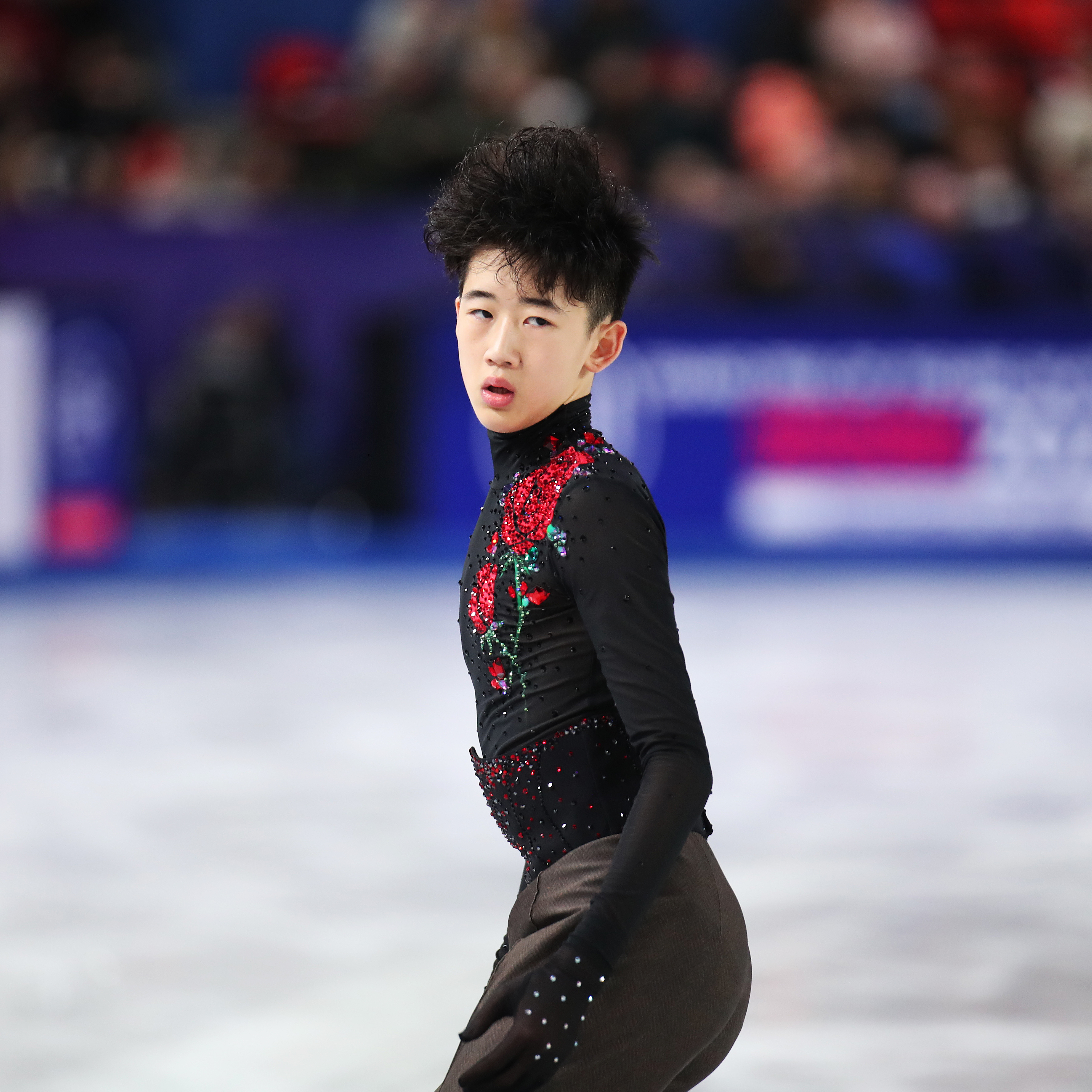
While in Grenoble, Li also had the opportunity to observe senior skaters who were there competing in the Grand Prix Final absorbing what he could to make himself a better skater.
“I really enjoy watching the seniors and then all the practices. It does give me some things to work on and then see how far I am compared to the seniors. I really liked the way they forced through the whole programme. Maybe there were some mistakes at the front, but they were able to push through it.
“I look up to Yuzuru Hanyu. He’s no longer competing anymore, so Ilia Malinin is a great motivation. His seven quad programmes are very impressive. I like Yuma’s deep knee bend, and then his ability to pick up speed easily. It’s something that I would like to work on.”
This week’s Junior Worlds will be his third time competing at the championships. In 2023, he came 26th in the short and missed the cut for the free. Last year, he was 12th. With no competitions since Junior Grand Prix Final, he planned to focus on increasing the technical difficulty in his routines.
“At Junior Worlds, I want to try to get a quad. I’ve been doing toe loops recently. They’ve been getting pretty close.
“I’m just doing toe loop because it’s kind of hard to juggle between doing quads and doing programmes.
“I might start to try quad Lutz and then quad Salchow. I’ve tried a few, but they weren’t that good.”
And what are his goals for this week in Debrecen?
“I would like to try and podium because the last two Junior Worlds weren’t quite the best performance I’ve given. I will try to make it different this time.”
Li will have to wait another while to compete as a senior man as he will have to remain a junior and miss out on competing at the Milano Cortina Olympics next year. He is philosophical about it taking him another five years to compete on the biggest global stage.
“I think a while ago I was pretty gutted, “ he said. “But now that I think about it, it’s great that I’m able to weigh off a little bit more, because this gives me time to improve on myself.
“I want to make the most of the junior season before I move up to senior. In seniors I will just to try to get as much experience as possible (before the 2030 Olympics).”
Li has a unique connection to the Olympics in that he was born on 12 August 2008 four days after the opening of the Beijing Summer Olympics.
“I think my mom told me she wanted me to be born on 8 August, but that didn’t happen,” he laughed.
His parents were unable to make the trip to Grenoble to see him compete and cheered him on from home back in New Zealand. He hopes that can change in the future as he makes more of a name for himself and raises the profile of the sport domestically.
“Because of financial reasons, it’s just my coach (who came with me to Grand Prix Final),” Li said “Right now we’re trying to get sponsors. We’re still in the process.
“Before I came to France, I did a few interviews locally, getting me some exposure.”

For a country with a population of just five million people, New Zealand punches way above its weight on the global sporting stage. At last year’s Paris Olympics, the nation bagged ten gold medals and finished 11th on the final medal table. Li is hoping he can add to that success in figure skating.
“I was watching most of the Olympics,” Li said. “It does feel really great to have this small country be able to achieve quite a lot, and then see it improve more and more. I’m glad to be part of the team that improves the sporting community.
“Figure skating was actually a really small sport and it’s not quite well known. After I came in 2017, I think it grew a little bit more. Now we have upcoming skaters that wanted to try the sport.”
 europeonice.com
One comment