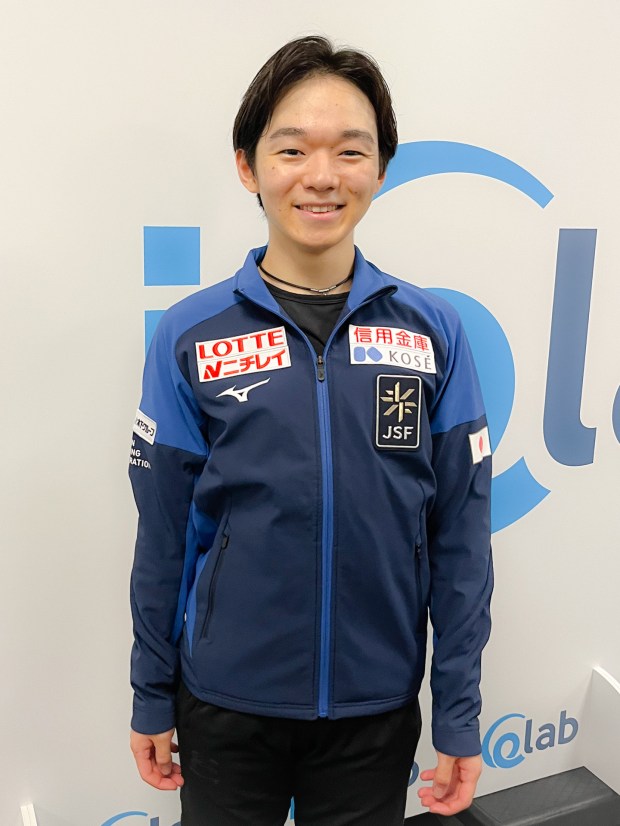
By Hiro Yoshida
While last season saw Yuma Kagiyama on the comeback trail following injury, this season the three-time World silver medallist and double Olympic silver medallist has his eyes firmly set on reaching the top of the podium starting with this week’s Japanese Nationals.
Kagiyama began this season at Lombardia Trophy in Bergamo, Italy back in September. It was the same event that a year earlier he had used to return to international competition, but this season he came into it with a different mindset.
“A year ago, I wasn’t yet at the level where I could compete with everyone else, but a year has passed since then and I feel like I’ve grown a lot both mentally and technically,” he said. “I was disappointed at the World Championships (in Montreal), but next season is the Olympic season, so I want to work hard to make sure I grow with each and every event.”
At Lombardia Trophy, Kagiyama found himself once again facing World champion Ilia Malinin who had pipped him to the title back in March. Despite initially being taken aback, having a rematch so early in the season did not faze him particularly.
“I was surprised at first, but since it was the first time I was showing off my new programmes for this season, I wasn’t thinking about comparing myself to anyone else and just wanted to focus on what I had to do,” he said.

Mistakes in both the short programme and free skating saw Kagiyama wind up second more than twenty points adrift of the American.
“After Lombardia Trophy, I focused on practicing the areas that I was lacking and the areas that the judges didn’t rate highly,” Kagiyama said. “I worked on brushing up the finer details of the steps in my short programme.”
It was almost two months later before the first of his Grand Prix assignments at NHK Trophy in Tokyo, Japan where he broke the three-hundred-point barrier for the first and so far only time this season. The following week he competed at Finlandia Trophy in Helsinki, Finland where he had a disastrous free by his own high standards but managed to hang on for the victory. He faced Malinin again earlier this month at the Grand Prix Final in Grenoble, France and once more had to settle for second place overall. However, this time he did beat the World champion in the free segment.
Compared to last season, Kagiyama has upgraded the technical content of his programmes, but he is fully aware that to compete with Malinin further improvements are required. He is currently trying to get comfortable with attempting four quadruple jumps in his free before adding further difficulty.
“At this point, I don’t have the time to think about one more quadruple, but first I want to make sure I can do this composition without making any mistakes,” Kagiyama explained. “Once it’s consistent, I’d like to add another quadruple. Right now, I’m practicing the quadruple Lutz, but first I want to get the quadruple flip and other elements consistent. From the beginning of the new year, if possible, I would like to include a quadruple flip in the short programme and a quadruple Lutz in the free programme. Unless I improve my components score, I won’t be able to catch up with Malinin, and I’m still not quite at the level of skating I want to achieve, so I think I need to take on more challenges.”
One of the areas where he has taken on new challenges this season is in his two routines created by renowned Canadian choreographer Lori Nichol. The free was put together first and was a departure in style for Kagiyama.
“I started working on the free programme as soon as the World Championships ended,” he said. “Because it was a challenge to choreograph a piece in a difficult genre like flamenco, I was at the rink all day, working on the choreography through trial and error. We finished it just before the time allotted to make it, but I think we managed to make something good.”

The routine utilises two pieces of music – “Romanza” from Concertino for Guitar & Orchestra in A Minor, OP. 7 by Karin Schaupp and Salvador Bacarisse and “Ameksa (District 78 Remix)” by Taalbi Brothers.
“When I first heard it, I got goosebumps and thought it was so cool,” Kagiyama recalled. “At the time I couldn’t imagine myself skating to this music. But as we actually choreographed it, I became interested in flamenco, modern movement, and its depth. Ice is a very difficult stage, but I think the key to it is how I can express flamenco with my own stamp on it, so I would like to improve my expression by taking lessons with Lori and Carolina (Kostner). I would like to perform the flamenco of my dreams.”
Kagiyama has worked with Nichol over the last few seasons, and they have gradually built a rapport when it comes to constructing new programmes together.
“Lori is very passionate about choreography, and she has really come to understand me over the past few years,” Kagiyama said. “As we were working on the choreography, I watched a lot of flamenco videos on YouTube to incorporate flamenco elements, and I often thought, ‘Oh, this movement is interesting, so I’ll try including it!’ It took a lot of time just to do the first movements, but even that was fun. I had never done flamenco before, so I made a lot of new discoveries. It was a time when I was able to grow a lot personally.”
“Romanza” also connects Kagiyama with two-time Olympic medallist and four-time World champion Michelle Kwan, another celebrated student of Nichol. The American famously skated to the piece when she won her first World title in 1996. For Kagiyama, the link Nichol provides to legends of the part is a valuable resource for him to draw upon.
“When I’m working on choreography with Lori, she often talks to me about the skating of John Curry and Michelle Kwan. I want to absorb this beautiful classic skating. I want to incorporate styles from various eras into my own skating and work hard to skate in a way that no one else can imitate.”
The choreography for Kagiyama’s short programme to “The Sound of Silence” started after the free was finished.
“Originally, I was wondering whether to use this song as an exhibition piece, but as we were choreographing it, I thought it would be more interesting to use it in the short programme, and the melody of the song also made me think it would be a new challenge,” Kagiyama said. “The melody is quiet until the second half, which means the sound of my edges stands out, so it’s even more difficult to skate quietly. It’s a tough programme because I have to do complex movements, but the reaction was good when I skated to it ‘Dreams On Ice’ and at Lombardia Trophy, so I’m glad I took on the challenge.”
While putting an enormous amount of thought and energy into the artistic aspect of his skating, Kagiyama recognises that he is competing in a sport where his main rivals are executing increasingly difficult technical elements. His goal to is to keep pace with them while staying true to the themes of the programmes he has created.
“This season, I’ve been doing four quadruple jumps for the first time in a while, so I often find myself thinking, ‘Jump! Jump!” Kagiyama said. “But if the jumps aren’t stable, I can’t focus on the expression. It’s not that the jumps have to be successful, but I don’t think you can have any leeway unless you make the jumps successful. In order to express yourself one hundred percent even if you fail, I think it’s ideal to be able to give one hundred percent without thinking, so I would like to become accustomed to doing that.”
Kagiyama feels that a belief in his own ability and working to discover where he can improve are what will serve him in competition.
“It’s hard to say what my strengths are, but people around me often tell me that my skating is beautiful, so I want to be confident in my skating and give consistent performances. Skating has many different elements and is a sport that can be enjoyed from many different angles, so I hope I can find my strengths, little by little.”
Kagiyama is well on his way to becoming a skater’s skater. In the mixed zone at Lombardia Trophy, Malinin mentioned how much he liked Kagiyama’s free and was sure it would go down very well at the World Championships next March in Boston.
“It’s rare that another skater tells me they like my programme, so I’m happy to hear Ilia say that,” Kagiyama said. “But I have to beat Ilia with this programme (laughs), so it’s going to be very difficult. I’ll do my best to give a performance that I can be satisfied with.”
This week Kagiyama’s focus is on finally becoming Japanese champion when he takes to the ice at Nationals in Osaka. While he has finished ahead of his domestic rivals internationally at the Olympics and Worlds, were he to win this would be the first time he would stand as the undisputed leading man representing his country. Despite his clear status as favourite to claim the title this year, he is taking nothing for granted.
“I think it is difficult to become number one in Japan and, when (Yuzuru) Hanyu and (Shoma) Uno were competing, it was the most difficult thing in the world,” he said. “Japanese Nationals is a tough battle that comes once a year and since it decides who will be sent to the major championships in the New Year, I think it will be very important for me to win Nationals in order to be selected for the World Championships. I have never won the Japanese title, so this year I want to aim for it and do my best to win.”
The Kagiyama family already has three Japanese national titles courtesy of his father and coach Masakazu who won the championships three times between 1991 and 1993. Both father and son being figure skating Olympians continues to be a source of media interest. However, it is not something Kagiyama dwells on too much, but he does acknowledge the uniqueness of two generations of the same family both being so accomplished.
“During the Olympics, I wasn’t thinking about things like that,” Kagiyama said. “I was just thinking about skating as hard as I could for myself. When I do hear that, I think it’s quite amazing.”

Once this season ends, Kagiyama will set his mind on being selected to represent Japan at a second Olympic Games. Despite having already achieved a silver medal in Beijing, he does not believe that will offer him any head start when it comes down to being chosen for the Japanese team.
“Yes, it’s true that I have competed in the Olympics once, but that is in the past now, and now I am in a position where I am working hard to aim for the Olympics just like the other skaters,” he said. “I don’t feel that I have an advantage or that I am leading the team, but I just want to work as hard as I can and grab a ticket to the Olympics. Right now, it’s unclear who will go to the Olympics from Japan. I can’t imagine who it will be either, and I think it will be a very tough fight, so I just need to stay focused and do my best.”
Over the summer, Kagiyama and the other members of the Japanese Beijing Olympic Figure Skating Team Event were finally awarded their silver medals at the foot of the Eiffel Tower during the 2024 Paris Olympics after a long wait due to the Court of Arbitration for Sport case involving the doping violation by Russian skater Kamila Valieva. Kagiyama appreciated receiving the medal in a very different atmosphere to Beijing as well as being able to enjoy an Olympics as a spectator.
“It was a medal ceremony after two and a half years, so it was very moving,” he said. “In Beijing, the ceremony was held without any spectators due to the COVID-19 pandemic. In Paris, a lot of people gathered, and the ceremony was held in an amazing place, and it was a once-in-a-lifetime experience. I was able to watch some events, and although there are always winners and losers in sport, I was inspired by the feelings of each athlete who was staking everything on the Olympics and how hard they worked. I am also currently aiming for Milan, so I was able to reaffirm my feeling that the Olympics are special.”
Kagiyama has already established an affinity with Italy thanks to working with Kostner, who coaches him alongside Kagiyama’s father Masakazu.
“I have competed in several competitions and attended training camps in Italy, so I have a pretty good grasp of the Italian atmosphere. It may feel different when I go there for the Olympics. When the Japanese national team had a training camp in Italy in August, I had the opportunity to see the athletes’ village and feel the local atmosphere.”
While Kagiyama appreciates all the accolades for his skating, he knows he still has further to go in his career.
“When many people praise my skating, it makes me think ‘I guess what I’ve been doing up until now was not wrong,’ and my current skating is the result of an accumulation of small things since I was little, so it’s also something I can be confident about. But as I continue to express myself in various ways, I think I can learn various forms of skating and aim higher. I want to become a skater that many people say is amazing.”
 europeonice.com