By Hiro Yoshida
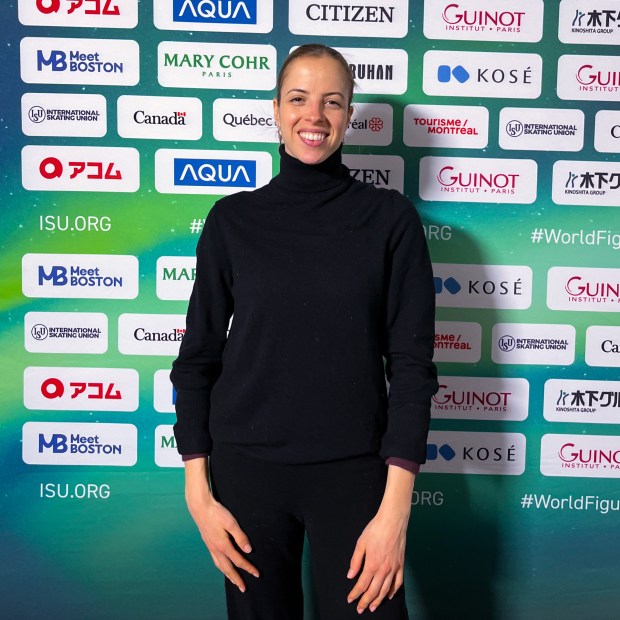
A decade on from famously winning an Olympic medal, Carolina Kostner is now on the other side of the boards guiding Japanese skater Yuma Kagiyama to the podium at the World Championships back in March. Despite her student’s success, the Italian is still finding her way as she embarks on a new career journey.
The World Championships in Montreal, Canada marked the end of a successful first season for the coach and her student with Kagiyama claiming a silver medal at the event. While it was Kagiyama’s third World silver, it was a new experience for Kostner.
“It was very exciting, very new, very different, but I enjoyed it a lot,” Kostner reflected. “I think I learned a lot. You see skating from a different perspective. You realise so many things. I can still learn and I can still improve. You learn to read also in between the lines of the skater you’re looking after. The moments where you don’t talk so much because it’s very tense. You communicate with body language and eye contact.”
Even though Kostner only began working as part of Kagiyama’s coaching team officially last summer, their paths had crossed before when Kostner was invited by the Japan Skating Federation to teach at a seminar. Kagiyama immediately left an impression on her.
“The first time I saw Yuma was at the Junior National camp in Chukyo in 2019,” Kostner recalled. “That’s the first time I taught a seminar. The skaters were so young. Kao (Miura) and Shun (Sato) and Yuma and Sena (Miyake). It was the use of his knees that made Yuma’s skating look very effortless and flowy.”
Kostner’s involvement in his career deepened further when she assisted her long-time choreographer Lori Nichol with Kagiyama’s programmes for the 2022 Beijing Olympic season albeit at a distance. The Covid-19 pandemic presented challenges and meant that Kagiyama, Kostner and Nichol could not work together in person.
“I was only present on Zoom to help Lori to convey her vision and her ideas and help her to underline aspects of the emotional part and what I think could be the emotion more so than the skating because over Zoom it was difficult to do,” Kostner said. “I think they did such an amazing job to create two beautiful programmes for the Olympic Games in such difficult circumstances.”
Kagiyama went on to win silver at the 2022 Beijing Olympics and also came second at the World Championships the following month. A left foot injury caused him to miss practically all the 2022-2023 season. As part of his recovery, he travelled to Italy in March 2023 to work with Nichol and Kostner in person. This enabled Kostner to fulfill a personal ambition.
“I think it has been a longtime dream of ours to one day work together and be able to help skaters grow and love what they do deeply as much as I learned to love my sport,” Kostner said about working with Nichol and Kagiyama. “We met for an art intensive three weeks in Italy last spring during Worlds in Japan and really concentrated on where we can improve and where he can find inspiration to implement his own skating. We would do classes in the morning on the ice and then we would have the other classes in the afternoon where we would go through different emotions, how we can portray them, how you can learn to portray them. You don’t necessarily always have to feel the whole emotion in order to let the audience feel it. Sometimes it’s actually the movement that creates an emotion in your body. Going through the different theories of what movement can be, how differently weight is in a movement. Is it moving through water? Is it moving through peanut butter? We really took time to dive deeply into those aspects of movement.”
The camp also provided inspiration for an exhibition number to “Werther”, an opera composed by Jules Massenet. A performance just so happened to be taking place in nearby Verona for the first time in 45 years and an excursion was made specifically to see it.
“We really enjoyed the opera,” Kostner said. “He (Kagiyama) got to dress up and enjoy the beautiful city centre of Verona, have some gelato, enjoy the opera and have us all inspired by how the actors told the story and how they used different forces and tones of voice. Is it telling you pain? Or is it telling euphoria? Or is it telling anger? Seeing it live makes a huge difference. It leaves you with something when you go home. The week after we started choreographing ‘Werther’ and we were all very inspired by that experience.”

A few months later during the summer of 2023 Kostner received an offer to become part of Kagiyama’s coaching team.
“I don’t know their decision-making process. They probably have thought about it, and we worked so well In Varese at the camp. The days flew so efficiently. I am very pleased and happy if they enjoyed working with me. I am honoured that they trusted my knowledge and my work to ask me to take on this challenge because for me too, and they were aware of that, it’s something new as well, and a learning process. I was quite surprised and honoured. Of course, I said I’m up to the challenge.”
When Kostner came on board, Kagiyama was still rehabilitating his injury. He and his coaching team were mindful of not rushing the recovery. Ultimately, Kostner believes the experience Kagiyama had dealing with the injury and the competitions and opportunities he missed out on, including a home Worlds, have made him a better skater and person.
“He followed a quite strict recovery programme, slowly implementing not only the different elements, but also the quantity of those elements, the execution of those elements and the training of those elements,” Kostner explained. “In training, many times we would actually keep a protocol on which jumps and how many jumps and how many repetitions and set a limit to how many were possible for this week and next week and see how it goes. It’s been a tough time for him to not know how quickly he can recover, how quickly the pain is gone, and when it’s gone, is it completely gone, or will it come back? How big is the risk that it can happen again? The good part is that he had the chance to learn how to deal with it, to miss out on a whole season, to miss out on Worlds in his home country and to learn how to deal with the expectations from first of all himself, and those around him and of course, also the skating world who have seen and appreciate his talent already, awarding him the silver medal at the Olympics.
“I think it’s very inspiring how determined, how consistent, how focused and how patient he has been.”
Last season, Kostner found herself standing on the same side of the boards as her old friend Stephane Lambiel, a contemporary from her competitive career, who coached Shoma Uno until the Japanese two-time World champion announced his retirement last month.
“I’ve been looking up to Stephane since we’ve met as a skater, and now as a coach,” Kostner said. “He’s also been a guide and advisor along the way. It’s been an honour to share the boards with him and to be able to inspire figure skating and give back to figure skating, something we spent a lot of time of our life doing and training for. My mission and my desire is to share that love for skating, that respect for skating, that gratitude because we are very lucky people to be able to be allowed to be here and just do what we love to do, being healthy, being talented. We have to honour having this chance to inspire so many people, to move so many people, to touch people’s hearts. I think it’s something very powerful and it should not at all be taken for granted.”
While Kostner is a World and five-time European champion, this year marks the tenth anniversary of her finally winning a coveted Olympic medal. Given how her two previous experiences at the 2006 and 2010 Games had ended, bagging bronze in 2014 felt like a victory for the Italian.
“It was very special. To me for sure it was like a gold.”
There was no immediate gratification either as, for the first time at an Olympics, the figure skating medals were not awarded immediately after the event, but at a separate venue the following day.
“That was a strange feeling,” Kostner said. “In those 24 hours, I tried to anticipate how I would feel and how it would be and how special and how lucky I was and how fortunate and how I would never forget. Then when I received the medal, I had this moment where I realised it’s not this moment I dreamed of. It’s all these years that I lived through to get to here. It’s the journey that actually I dreamt of and that I feel so lucky to have. That was a breakthrough moment for me to understand that. We all dream of the results and the medals, but at the end of the day, the big value of the journey is all the things you learn along the way, the friends you make, the places you see, the experiences that make you wiser and stronger and more knowledgeable and probably also more empathetic and understanding towards life. It was a very special time and a very special feeling. Whenever I think of Sochi and the medal, I think of all those years I put my energy into it, especially those days when I remember hearing the alarm clock in the morning and being worried about how would I get to the evening? Waking up, going to school, coming back, homework and training and homework and back to training. It’s been a long journey to where I am. To me it’s been invaluable and I’m very grateful.”
Apart from Nichol, during her competitive career Kostner had the opportunity to work with many legendary coaches, including Michael Huth, Alexei Mishin and Frank Carroll, but is acutely aware that a skater with many competitive achievements does not always have the aptitude to become an equally successful coach.
“I feel absolutely fortunate to have the chance to learn from all these amazing professionals and coaches. Everyone in their own way added to my path and added to my journey. I’m very thankful that they spent the time with me and for me shared their knowledge and their passion for my skating and I absolutely learned from each one of them.
“I don’t take it for granted that being a great athlete, you’re also at the same time a great coach. I think it takes time and it takes a lot of experience. I hope one day to be a very good coach. Right now, I hope to inspire my skaters to believe in their dreams and believe in their unique journeys. As I know, it took me many years to win. Others it took a very short time. Everyone is so unique. But it’s you who needs to want it and needs to find your solutions. Your staff can help you. We can help you to find the right weapons to fight the right battles. But at the end of the day, it’s the skaters who go out there and have their fate and their future in their hands.”
Even though many of its top draws have retired in recent years, figure skating still commands enormous media attention in Japan. Having also been a high-profile athlete in her native Italy, Kostner understands the pressures and demands probably better than many as she continues to work with Kagiyama and is happy to now be in a supporting role.
“I enjoy being in the background,” Kostner said. “I enjoy being away from the spotlight, but I also think it is a pleasure to be able to tell the story and to let people know what figure skating is for me or for many other skaters. Even though we all know that for the athletes sometimes it’s not easy to handle the attention which creates pressure and tension, on the other hand, we do understand that it’s part of our story and I think fans deserve to know what the programme is about and you’re able to tell them your story.”
Kostner still appears in shows when the occasion arises and clearly relishes performing for audiences and telling stories through her skating.
“I had the honour to perform in Fukuoka in January. During my hip surgery and my recovery, I had no idea whether I would ever perform again for the public. Lori created this number inspired by how the butterfly is inside the cocoon and when it is ready, it will just spread its wings and fly. I said to Lori, ‘I don’t want people to be disappointed when they see me.’ Of course, I am not the 2014 Olympic medal version of myself because I know I am not that version anymore. I’m a different skater now. I’m a different person now. I said, ‘Well, why don’t I start the choreography by actually telling my story and give them an understanding that this is who I am now, and I want to inspire people to believe in their dreams and continue along their journey.’ It was made in Italian because I mostly performed it in Italy. When I had the chance to perform it in Japan, we translated the words, and it was very special to be able to convey my message in Japanese and I hope that the audience understood what I was saying.”
While skating is a sport, ultimately Kostner believes first and foremost it is a form of physical creative expression and a sanctuary for her.
“Yes, there are many rules and yes, sport requires discipline and patience and determination. But our sport has the beauty to also give you that freedom. When I skate, I feel freedom. I feel freedom to feel accepted for who I am with my flaws, especially now that I have lived through good moments and very bad moments and very difficult moments, very exciting moments. Whenever I take to the ice, I feel free. The girl that was very shy and very timid and very doubtful as a kid now is assured. You will always have your safe spot there where you can skate on an empty training cold practice rink, in a beautiful arena, outside in nature and you’re always at home.”
A Japanese version of this interview is available in the May issue of Figure Skate Life.
 europeonice.com