
By Hiro Yoshida
Minerva Fabienne Hase and Nikita Volodin are the rising stars of German pairs skating, but their trajectory in their debut season has not so far been all plain sailing.
Hase and Volodin competed in their first international competition together in Lombardia Trophy in Bergamo, Italy last September where they claimed the silver medal. Later that month, they bagged the Nebelhorn Trophy title in Oberstdorf, Germany. Their season went from strength to strength when they won back-to-back Grand Prix events in Finland and Japan and qualified for the Grand Prix Final in Beijing China. They fended off their more fancied rivals to sensationally take gold and set themselves up as the outstanding favourites to win the European Championships. They wrapped up 2023 by winning the German Championships
Shortly after their national title victory, Hase became ill causing the pair to lose valuable training time before their departure for Europeans. In Kaunas, Lithuania, they finished a solid second place in the short programme. However, their free skate was peppered with mistakes and most fatally an aborted lift. They dropped to fifth place overall. While unable to hide their disappointment, the pair were able to put it into perspective as a minor bump early on in the journey of their competitive career.
“For me personally, I had big expectations going into this competition,” Hase said. “I think we both had. We wanted to have a podium place for sure. This was a thing we expected from ourselves. Going into the competition as favourites, maybe we put a little bit too much pressure on ourselves or wanted it too much. Especially I got a little bit tense throughout the competition. Maybe it’s better now so to stay back on Earth and also see that we are just a new pair and we can make mistakes. Our coach always said there will be a moment when it’s not going to go well. We cannot continue to just keep being on the same standard all the time. He said it was just a matter of time before something happens at a competition. It was sad that it was at Europeans. Luckily, we have the World Championship coming up so we still have one competition to prove ourselves that this was a one-time thing. We will work hard for this to do better at Worlds.”
Hase and Volodin were brought together by their coach Dmitri Savin, who had trained Hase with her former partner Nolan Seegert in Sochi, Russia. Originally from Saint Petersburg, Russia, Volodin previously represented his home country internationally, but had never competed at a senior ISU championship. Prior to teaming up with Hase, he was performing in ice shows with among others two-time European pairs champion Yuko Kavaguti. Before my interview with Hase and Volodin, I had been in contact with Kavaguti who spoke highly of Volodin as a skater, in particular his twist lift technique. It had always been an element that Kavaguti had disliked with her other partners. However, with Volodin, she had come to enjoy it. Hase felt similarly.
“I hated twist before as well with my previous partner, but with Nikita twist is so easy,” Hase confirmed. “Now it’s one of my favourite elements. He has really good twist technique and also on lifts.”
“I have different twist with all partners, but best twist is with Minnie now,” Volodin said. “It’s a partner trick because it’s all about working together, about gauging, about pushing. It looks like the boy is just pushing his partner, but that’s not right. It’s about working together.”
Hase and Volodin also have in mind the future idea of performing a quadruple twist in competition, although for now they are focused on attaining a higher level on their triple.
“It’s also something we want to try during our partnership because I think, if we improve our twist a little bit more and get more height, it’s possible,” Hase said about the quad. “We still don’t have Level Four because of my split. We will work hard now after Europeans because we need that Level Four to get the highest points. All the other elements are basically Level Four, so it’s the last element we need and I want to get my split. It’s one of my goals for the next season.”
“Now it’s not so important because it’s not so many points,” Volodin said. “For the Olympic Games, we need to be ready to have all Level Four because there are so many good pairs always and it’s so close. You need all the levels you can get.”
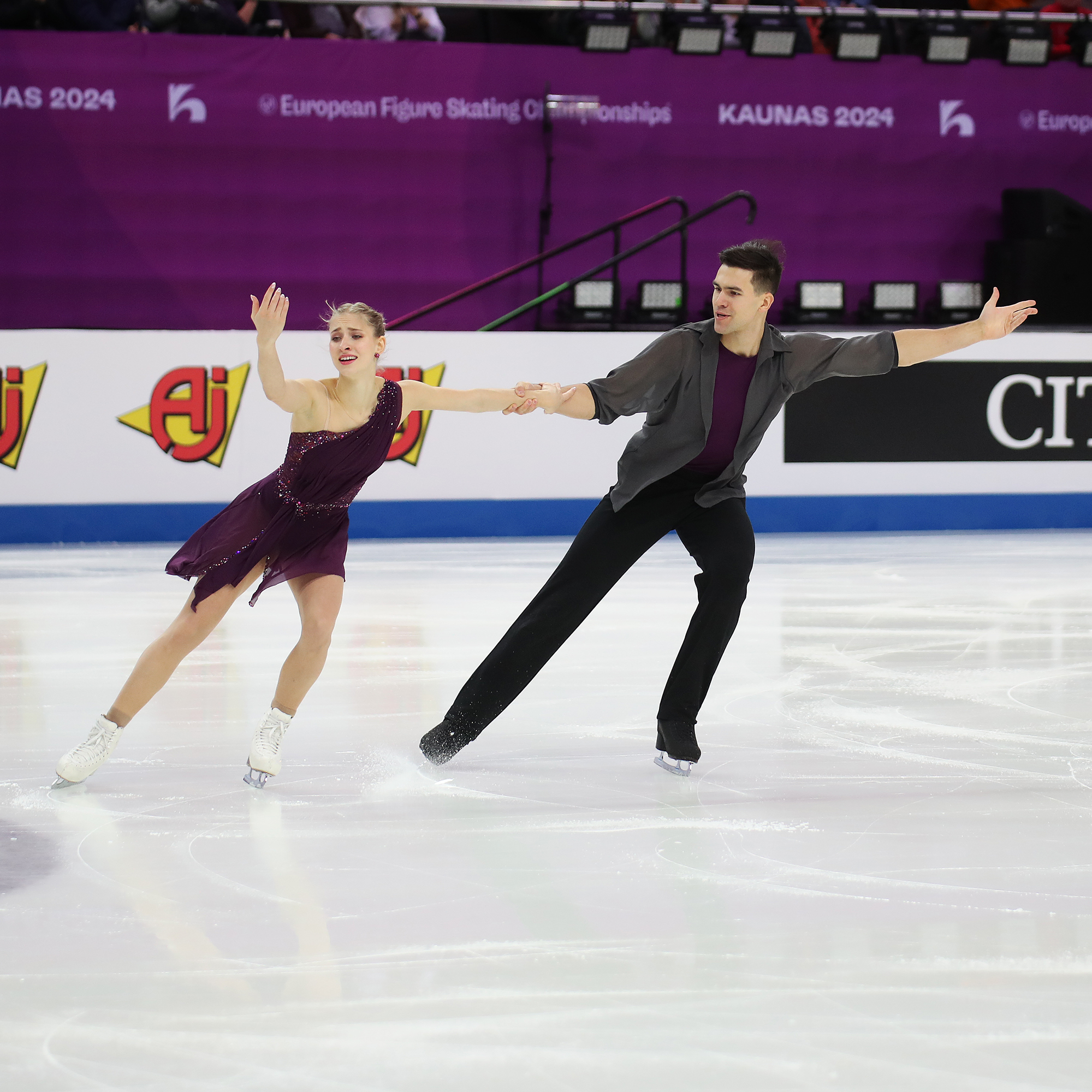
In contrast to their twist, Hase and Volodin find other elements more challenging.
“I don’t like to do spins because I always get really angry super-fast if it’s not working because it’s an easy element,” Hase said. “I’m a perfectionist, so I love when elements are perfect. When we struggle on elements, I’m not the most patient one.”
“My least favourite element is loop throw because I always have to give full power for this and I cannot economise,” Volodin said. “After it when you go to do a lift in the programme, it’s also hard.”
“We have to work on our loop throw too,” Hase agreed. “In the short programme, it’s not a problem because we just have that one throw and he has enough energy. But in the free program with having the hard combination in the beginning and the Salchow after and then the loop is the fourth element, it’s always a little bit tough.”
Even though Hase and Volodin developed their technique in two different countries, it has not proved to be much of an adjustment to skate together. Hase has been working with Savin since 2021 and being somewhat familiar with the Russian style of pair skating has naturally been an advantage. The pair credit Savin for giving each of them what they need to make the partnership work.
“There’s some different method, but Minnie was training with a Russian coach,” Volodin said. “It’s like a Russian partner for me.”
“I really like to skate with Nikita because of his Russian mentality,” Hase said. “He can always push himself beyond limits which I didn’t know it’s possible to push over. In the beginning, it was really challenging for me because it was so much more pushing and practicing and I had to tell him in the beginning many times to stop for a moment. But it helped me become a better athlete now and also build more strength in my mind. He helps me with that and now I have the feeling I can take his power and also push one hundred percent like he does. For me it was new, but I like it. This is what I always wanted – a partner who keeps pushing also through tough times and he is that partner now.”
“Dima is not a typical Russian coach,” Hase explained. “He has the technique of the Russians, but he’s much more also in emotions and paying more attention to our feelings.”
“For Russians, Dima is a Russian coach,” Volodin added. “For others, for Minnie, he’s a different coach.”
“He’s doing a mix with us,” Hase continued. “He wants to push us and he also writes plans with programme content, which sometimes I think, ‘Are you serious?’ With the Hungarians (Maria Pavlova and Alexei Sviatchenko), for example, because they’re both Russians, he’s much harder on them and much bossier. Especially with me because he knows me for so long, he knows that I will put pressure on myself. He doesn’t have to push me extra to do more. He’s a little bit softer on me and on Nikita too because he sees that Nikita is pushing so he doesn’t have to push us as a pair.”

Hase and Volodin are based in Berlin, Germany for training. Berlin is Hase’s hometown. While Volodin has settled in, it took him a while to get used to certain things.
“First my family and second my home,” Volodin said when I asked about what he missed from Russia. “It’s cheaper to live and shops are always open. In Berlin, shops close at eight o’clock and don’t open on Sundays. For me after one year, it’s now normal.
“In Berlin live so many nationalities. It’s mixed and not just German. I like Berlin shawarma. It’s so good. There is so much space and the zoo with many different animals.”
“I grew up in Berlin and lived there my whole life,” Hase said. “I love Berlin. I know what I can do on a Sunday, so I think he has to explore a little bit more. But I also have my friends there, so of course I can meet with them and have game nights or something. I can understand if I didn’t have this system in Berlin, it would be not the best city. I had that with Nolan when I was in Sochi and preparing for Olympics. I didn’t have a lot of people there and it’s just a different feeling to get to know a city when you don’t have that.”
With Hase being German and Volodin a Russian citizen representing Germany, inevitably there is quite a lot of talk about the hurdles to be cleared to enable the pair to compete at the Olympic Games. While there are strict criteria still to be met in terms of residency and language ability, they believe that it is an achievable goal.
“We’re working,” Hase said. “It will be close to get the passport, but it’s possible. We will do all we can do as athletes. After the season. we will focus more on his German and get him a German tutor.
“He will have a German exam. It’s a little bit about history and about the system in Germany, speaking in German, writing so a little bit of everything. That’s why we also want a German teacher who knows what he needs to learn to get through these tests. It’s just more efficient because we just don’t have so much time.”
“I think it’s important that I speak some German for a German passport.” Volodin said.
“We talk to each other in English all the time,” Hase said.
“Or Russian,” Volodin laughed. “It’s like sometimes I forget.”
“Especially when Dima is with us and he’s talking Russian with Dima then he’s talking in Russian with me,” Hase said. “Sometimes I understand a tiny little bit.”
“I understand you in German the same,” Volodin joked. “We speak in English for now. I think if I studied German, I’d be better in German.”
“It’s two more years,” Hase said. “From what I understand. we need the passport till December of the Olympic season. That’s the latest point. Until then we have time to get everything done.”
For now, Hase and Volodin are mostly looking ahead to next month’s World Championships in Montreal, Canada, and a chance for redemption after Europeans.
“My psychology is the same for all competitions,” Volodin said. “You try to do more. You try to push. You don’t think about placements. You just do your work and after you check what scores it brings you and which place you get.”
“A podium would be nice,” Hase said. “I think now we’re a little bit more settled, and two solid programmes will give us a podium. I try not to think about a medal for Worlds. I try to just push on the practice, get secure on our elements, and then put everything in for the performance there. We will see if it’s enough to win. I think for sure we have the potential.”
 europeonice.com
One comment